
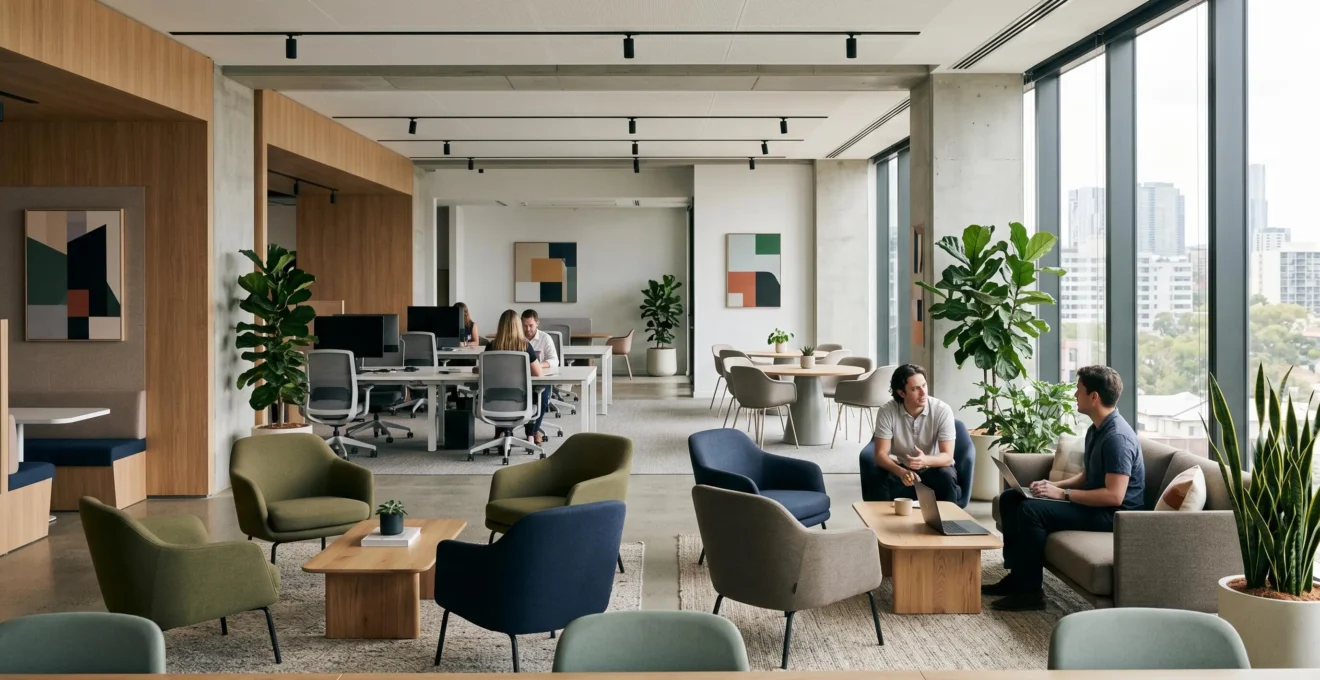
Creating a ‘destination office’ is a financial strategy, not an interior design project.
- Success hinges on data-driven decisions (occupancy, energy use) and savvy lease negotiation (incentives, reinstatement clauses).
- The goal is to maximize the ‘Return on Commute’ for employees and deliver tangible ROI for the business.
Recommendation: Stop guessing. Use data and strategic financial planning to justify every square foot and design choice, turning your office from a liability into a competitive advantage.
The modern workplace is at a crossroads. For many corporate tenants, the office floor echoes with the quiet hum of servers and the louder question from the CFO: “Why are we paying for all this empty space?” In the post-pandemic era, the default has shifted. The office is no longer a given; it’s a choice that employees make each day. This puts immense pressure on landlords and tenants alike to answer a critical question: how do you make the office a place worth the commute?
The knee-jerk reaction has been a frantic arms race of amenities—better coffee, more snack bars, perhaps a token ping-pong table. But this approach mistakes perks for purpose. It fails to address the fundamental issue that employees are not just looking for a more fun office; they are weighing the value of their time, focus, and productivity against the cost and effort of commuting. The real challenge isn’t about out-perking the home office; it’s about out-performing it.
This guide reframes the conversation. The ‘destination office’ is not born from a bigger budget for beanbags, but from a smarter strategy that blends real estate finance, HR objectives, and data-driven design. It’s about the financial engineering of space to deliver a quantifiable ‘Return on Commute.’ We will dissect the true costs, the data that matters, and the critical lease clauses that can make or break your transformation. This isn’t just about surviving the shift to hybrid work; it’s about turning your physical workspace into your most powerful strategic asset.
In this comprehensive guide, we will explore the critical financial and strategic levers for creating a workspace that actively earns its keep. The following sections break down everything from initial fit-out costs and space calculation to leveraging incentives and avoiding hidden liabilities.
Summary: The Strategic Blueprint for a Commute-Worthy Workspace
- How much does it cost per sq ft to fit out a modern hybrid office in London?
- Desk sharing ratios: How to calculate the square footage needed for a hybrid workforce?
- Occupancy sensors: How to use data to reduce energy bills in a hybrid office?
- Rent free vs Capital contribution: Which incentive helps you fund the hybrid transformation?
- Reinstatement costs: The hidden bill for removing your fancy hybrid fit-out?
- Wellness and bike racks: What features do modern corporate tenants actually demand?
- Cat A+ fit-outs: Should landlords fit out the office to attract tenants faster?
- Grade A vs Grade B: Why older offices are becoming unlettable ‘stranded assets’?
How much does it cost per sq ft to fit out a modern hybrid office in London?
The first step in any strategic transformation is understanding the investment required. In the world of office fit-outs, London stands alone. The cost of creating a high-specification hybrid office is not for the faint of heart. A recent analysis reveals that transforming a shell into a destination workspace is a significant capital expenditure, with high-end fit-out costs reaching approximately £434 per square foot. This figure places London at the top of the global league table for office fit-out costs, driven by a confluence of factors.
As Nadia de Klerk, Global Head of Occupier and Retail at Turner & Townsend, explains, the market is experiencing a unique pressure. She notes:
In London we are seeing a perfect storm. The gathering pace of return to office working, coupled with skilled trades shortages and high building material prices, have resulted in commercial fit-out costs being the world’s most expensive.
– Nadia de Klerk, Turner & Townsend
However, this high cost doesn’t mean the project is unfeasible. It simply means that every pound must be spent with intention. It forces a shift away from simply filling space towards strategically optimising it. The goal is no longer to provide one desk per person, but to provide the *right* type of space for the tasks that bring people to the office.
Case Study: Smarter, Not Bigger, Space Utilisation
A London-based communications agency provides a powerful example of this new mindset. They successfully reduced their desk count from 200 to 100 while retaining their existing office footprint. This wasn’t a downsizing; it was a strategic redesign. By implementing creative layouts, diverse breakout areas, and a cloud-based booking system, they created a more flexible and dynamic environment. This case study demonstrates that a successful hybrid transformation is about optimising space utilisation, not necessarily reducing total square footage, proving that high fit-out costs can be offset by smarter design.
Desk sharing ratios: How to calculate the square footage needed for a hybrid workforce?
With fit-out costs at a premium, the old model of one employee, one desk is financially obsolete and spatially inefficient. The key to a cost-effective destination office lies in accurately calculating the space you *actually* need. This begins with moving beyond simple headcount and embracing desk sharing ratios, also known as employee-to-seat ratios. This metric is the cornerstone of hybrid workplace planning, allowing you to provide enough space for peak demand without paying for perpetually empty desks.
The industry benchmark has shifted dramatically. While pre-pandemic ratios were close to 1:1, companies now target 1.4 to 1.8 employees per seat. This means for every 10 seats, you can accommodate between 14 and 18 employees. This is possible because even at peak times, hybrid work patterns mean utilisation rarely hits 100%. This data-driven approach immediately reduces the need for traditional desk space, freeing up both square footage and budget for other types of environments.
However, calculating the right ratio is more than a simple mathematical exercise. It’s about understanding work typologies. The calculation must be broken down by activity: how many collaboration zones are needed versus quiet focus pods? How many informal meeting spaces versus formal boardrooms? A successful hybrid office is a “neighbourhood” of different zones, each with its own density and purpose. The goal isn’t just to reduce desks, but to reallocate that saved space and budget into a richer variety of work settings that a home office cannot replicate.
Occupancy sensors: How to use data to reduce energy bills in a hybrid office?
Once you’ve designed your hybrid space based on new ratios, how do you validate your assumptions and optimise operations? The answer is data. Occupancy sensors are the nervous system of the modern office, transforming it from a static container into a responsive environment. Their most immediate and compelling benefit is a direct impact on the bottom line through significant energy savings. In a hybrid model with fluctuating occupancy, heating, cooling, and lighting an empty floor is a major source of financial waste.
Sensors combat this by ensuring energy is used only when and where it’s needed. When a meeting room is empty, the lights and HVAC automatically power down. When a section of the office is unused on a quiet Friday, its energy consumption is minimised. The cumulative effect is substantial. While overall building savings can be significant, the granular impact on specific areas is even more impressive. For instance, research demonstrates that lighting savings with occupancy sensors can reach 20%-65% in conference rooms and 30%-90% in restrooms. This isn’t just cost-cutting; it’s a critical component of any corporate sustainability (ESG) strategy.
But the value of occupancy data extends far beyond energy bills. It provides a continuous feedback loop on how your expensive, newly designed space is actually being used. Are the collaboration pods popular? Are the focus booths underutilised? This data is invaluable for making informed decisions about future design iterations, reconfiguring underused areas, and proving the ROI of specific spaces. It allows you to move from “we think” to “we know,” justifying the existence of every square foot. By linking space to utilisation, you build a powerful business case for continuous investment and optimisation, making the office a truly data-driven asset.
Rent free vs Capital contribution: Which incentive helps you fund the hybrid transformation?
Securing the perfect space is only half the battle; funding its transformation is the other. In a tenant-friendly market, landlords are often willing to offer significant incentives to secure high-quality, long-term occupants. Understanding these incentives is a critical piece of the financial engineering required for a destination office. The two most common forms are a ‘rent-free’ period and a ‘capital contribution’ (CapCon).
A rent-free period is a waiver of rent for an agreed number of months at the beginning of the lease. This is excellent for a company’s immediate cash flow, as it reduces outgoing expenses during the often-costly period of moving and settling in. However, it does not provide any upfront cash to actually pay for the expensive fit-out.
A capital contribution, by contrast, is a sum of money paid by the landlord directly to the tenant to put towards the cost of the fit-out. While it doesn’t reduce the monthly rent obligation, it provides the immediate, liquid capital needed to build your new workspace. The scale of these contributions can be vast; capital contributions on office fit-outs range in size from a few thousand pounds to well in excess of £10 million for major corporate lettings. For a business embarking on a transformative hybrid fit-out, the capital contribution is almost always the more powerful and strategic choice.
Choosing a capital contribution allows you to fund your vision without draining your own capital reserves. It enables you to invest in the high-quality finishes, technology, and diverse settings that define a destination office. This turns the landlord into a financial partner in your success. When negotiating your lease, framing your request for a significant CapCon as an investment that increases the long-term value of the landlord’s asset can be a highly effective strategy.
Reinstatement costs: The hidden bill for removing your fancy hybrid fit-out?
You’ve negotiated a great lease, secured a generous capital contribution, and built a stunning destination office. But what happens when the lease ends? Lurking in the small print of most commercial leases is a clause that can present a nasty financial shock: the reinstatement (or ‘dilapidations’) clause. This clause typically obligates the tenant to return the property to its original condition at the end of the lease term. This means your expensive, bespoke fit-out—the very thing that made the office a destination—may have to be ripped out at your own expense.
This “hidden bill” can run into hundreds of thousands, or even millions, of pounds. It includes not just the removal of partitions and furniture, but also complex work on lighting, data cabling, and HVAC systems. Furthermore, this obligation can create perverse incentives, discouraging tenants from investing in high-quality improvements that they know they will simply have to pay to remove later. This risk is compounded by other clauses, as legal experts at TenantCS warn.
Incentive clauses often include a ‘clawback’ right which will allow landlords to reclaim all or part of the value of the incentive if the lease is terminated early.
– TenantCS, Lease Incentives: The Ultimate Guide For Commercial Tenants
The key to mitigating this risk is to address it head-on during the initial lease negotiation, not at the end. By being proactive, you can define the terms of your exit before you even move in. This is a critical part of the financial strategy for any major fit-out, ensuring your investment is protected and your exit is financially predictable.
Action Plan: De-risking Your Lease Exit
- Specify the Baseline: Clearly define what constitutes a ‘standard’ or ‘baseline’ fit-out in the lease agreement to establish expectations for the handover condition.
- Classify Fixtures: Negotiate and document whether certain high-value improvements (especially mechanical & electrical systems) are classified as landlord’s fixtures (which stay) or tenant’s chattels (which are removed).
- Agree a Cash Settlement: Explore the option of agreeing on a fixed cash settlement amount at the start of the lease, which would be paid in lieu of performing the physical reinstatement work at the end.
- Differentiate Works: Use the lease to clearly separate Category A works (landlord’s base build) from Category B works (your bespoke improvements) to clarify reinstatement responsibilities.
- Link to Rent Review: Document which of your improvements will be taken into account when fixing market rent on review. If an improvement increases the property’s rental value, you can argue it should not be removed.
Wellness and bike racks: What features do modern corporate tenants actually demand?
With the rise of hybrid work, the C-suite is scrutinizing real estate costs like never before. Indeed, research indicates that 73% of CEOs are reevaluating their real estate ROI. This pressure means that office features can no longer be a random collection of ‘nice-to-haves’. Every amenity, from wellness rooms to bike racks, must contribute to the central goal: making the office a compelling destination. So, what do tenants and their employees actually demand?
The answer is less about specific perks and more about the quality of the overall experience. As the workplace specialists at Interaction put it, the modern office must offer something truly valuable.
If companies want people to give up home comforts to slog it to the office a few days a week – they need to offer them something genuinely beneficial and enticing. This often takes the form of a ‘destination’ office – a space that provides a unique experience with amenities that cannot be replicated at home.
– Interaction, The Interaction guide to hybrid office design
This “unique experience” is built on a foundation of features that support the very reasons people come to the office: collaboration, concentration, and connection. This translates into specific demands:
- Seamless Technology: Flawless video conferencing, easy-to-book rooms, and fast Wi-Fi are non-negotiable. Technology friction is a major reason people prefer to work from home.
- Acoustic Privacy: Open-plan offices are notorious for noise and distraction. The number one demand is for a variety of quiet spaces, from single-person focus pods to acoustically sealed meeting rooms.
- High-Quality Collaboration Zones: Spaces designed for creative, collaborative work with digital whiteboards, flexible furniture, and great lighting are essential for team-based tasks.
- True Wellness Features: Beyond plants, this means excellent air quality, access to natural light, ergonomic furniture, and spaces for genuine rest and rejuvenation, not just a noisy breakroom.
Bike racks and better coffee are part of the equation, but they are supporting elements, not the main event. The real demand is for a frictionless, high-performance work environment that respects an employee’s time and enables them to do their best work.
Cat A+ fit-outs: Should landlords fit out the office to attract tenants faster?
In the competitive battle to attract and retain tenants, landlords are increasingly forced to rethink their traditional offerings. Historically, a landlord would provide a ‘Category A’ space: a functional blank canvas with raised floors, suspended ceilings, and basic services, leaving the tenant to handle the full bespoke ‘Category B’ fit-out. However, in a market where speed and convenience are paramount, a new model is gaining traction: the ‘Category A+’ or ‘Plug and Play’ office.
A Cat A+ fit-out is a landlord-funded, pre-fitted space that goes far beyond the basic shell. It includes everything a tenant needs to move in and start working almost immediately: partitioned meeting rooms, a kitchen, furniture, and data cabling. This model dramatically reduces the tenant’s upfront capital expenditure and shortens the timeline from signing the lease to occupying the space from months to weeks. For tenants, especially those in fast-growing sectors or those hesitant to commit large capital sums, this is an incredibly attractive proposition.
This trend represents a fundamental shift in risk and investment from the tenant to the landlord. By shouldering the cost of the fit-out, landlords are making a speculative investment to make their property more marketable and reduce costly void periods.
Case Study: The Rise of Speculative Landlord Fit-Outs
Since the pandemic, there has been a notable increase in landlords of larger office buildings undertaking ‘Cat A+’ fit-outs speculatively. They are no longer waiting for a tenant to sign a lease before investing. Instead, they are proactively designing and fitting out floors to appeal to specific target tenants in their marketing efforts. This strategy recognizes that in the current market, removing barriers to occupancy and offering a turnkey solution can be the deciding factor in accelerating a letting and securing a high-quality tenant faster.
For landlords, offering a Cat A+ solution is a calculated gamble. It requires a significant upfront investment and a deep understanding of what the target market wants. But in a “flight to quality” market, providing a ready-made destination office can be the most effective way to stand out and ensure their asset is the one that gets chosen.
Key takeaways
- Treat the office as a strategic asset to be optimised for ROI, not a fixed cost to be minimised.
- Use data from occupancy sensors and workplace analytics to drive design and operational decisions for measurable results.
- Mastering lease negotiation, from upfront capital contributions to backend reinstatement clauses, is as crucial as the physical design for financial success.
Grade A vs Grade B: Why older offices are becoming unlettable ‘stranded assets’?
The shift to hybrid work has not affected all office buildings equally. A clear and accelerating bifurcation is occurring in the market: a “flight to quality.” Companies are abandoning older, less inspiring Grade B and C buildings in favour of modern, amenity-rich, and sustainable Grade A properties. This trend is creating a growing class of “stranded assets”—older office buildings that are becoming difficult, if not impossible, to lease without massive capital investment.
Why is this happening? If companies are reducing their overall space, they want the space they *do* keep to be exceptional. They are consolidating their workforce into the best possible environments to create a compelling destination that justifies the commute. A drab, poorly-lit office with outdated facilities simply cannot compete with the comfort and convenience of working from home. These older buildings often lack the features modern tenants demand: high-speed connectivity, advanced air filtration, flexible floor plates for hybrid design, and strong ESG (Environmental, Social, and Governance) credentials.
This isn’t a localized phenomenon. It’s a global trend driven by the world’s most powerful economic hubs. As a report cited by The Economist highlights, the smart money is doubling down on quality.
An article by The Economist detailed how richer cities across the globe, citing New York, Hong Kong and Paris besides London, are investing more rather than less in office space, despite costs and the economy, in a bid to attract tenants and workers back in, with high-end luxury spaces and green buildings topping the trends.
– The Economist, Cited in OP Group office fit-out costs analysis
For landlords of Grade B properties, the writing is on the wall. Doing nothing is no longer an option. The choice is stark: either invest heavily to upgrade the building to meet modern standards or risk holding an obsolete, unlettable asset with diminishing value. For tenants, this reinforces the importance of choosing a building that is a long-term asset, not a short-term liability. The quality of the building itself has become a critical tool in the war for talent.
The era of the office as a passive container is over. To attract top talent, foster collaboration, and justify its place on the balance sheet, the workplace must become a strategic, high-performing asset. The next step is to begin an audit of your portfolio and strategy, not as a cost-cutting exercise, but as a value-creation opportunity.