
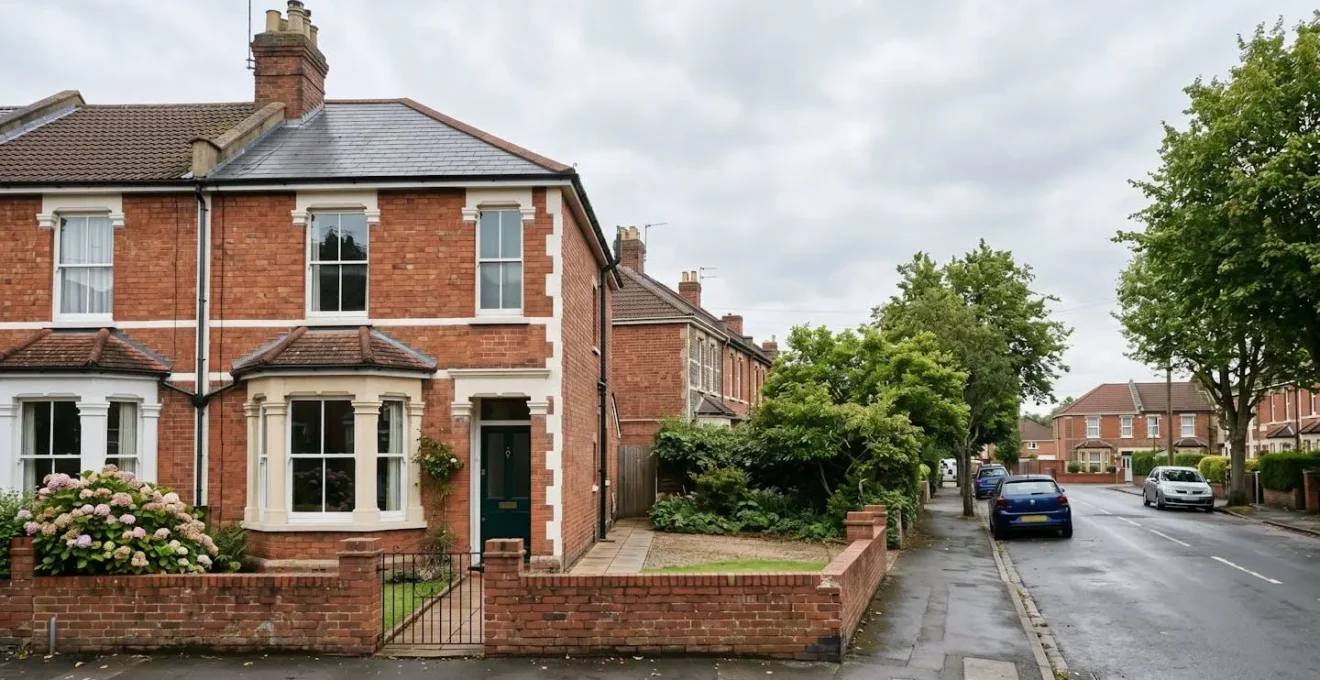
In summary:
- Genuine extension potential isn’t about vision; it’s about navigating a maze of legal and planning constraints before you buy.
- Permitted Development Rights are not a given; they can be removed by past extensions, location, or specific council directives like Article 4.
- The most significant risks are often invisible: missing building control certificates, private ‘Right to Light’ claims, and restrictive covenants in the deeds.
- Successful conversion projects (like office-to-residential) hinge on passing strict ‘Prior Approval’ checks on issues like flood risk and natural light.
- De-risking your investment means conducting thorough “planning forensics” on a property’s history and limitations, not just its current state.
The dream of the ‘doer-upper’ is a powerful one: buying a property with untapped potential, extending it, and creating both your perfect home and a significant financial asset. Many buyers rely on a simple glance—”the neighbours have a loft conversion, so we can too”—or the estate agent’s optimistic brochure. This is often the first, and most costly, mistake. The gap between a property’s apparent potential and its legally permissible development capacity is littered with rejected applications, unforeseen costs, and bitter disputes. Finding a property with genuine potential isn’t about architectural vision alone; it’s about risk management.
Common advice revolves around checking the Planning Portal or looking at nearby houses. While not wrong, this approach is dangerously superficial. It fails to account for the intricate layers of control that dictate what you can and cannot build. These include everything from the property’s specific planning history since 1948 to local council policies targeting HMO saturation, and even centuries-old private legal agreements hidden in the deeds. The real key to unlocking value is not just to think like a builder, but to think like a seasoned planning officer and a cynical solicitor, actively hunting for the red flags that kill projects dead.
This guide abandons the generic advice. Instead, we will adopt the mindset of a planning consultant, conducting forensic due diligence before you even make an offer. We’ll dissect the rules that allow some extensions to bypass full planning permission, but also explore the specific restrictions—like Conservation Areas, Article 4 Directions, and Right to Light claims—that can stop your project in its tracks. By understanding the “why” behind the rules and learning to spot the warning signs, you can build a clear development risk profile for any property, transforming a hopeful gamble into a calculated investment.
This article provides a structured approach to your pre-purchase investigation. Each section tackles a critical layer of planning and legal constraints, guiding you through the essential checks that define a property’s true development ceiling.
Table of Contents: A Buyer’s Guide to Uncovering True Development Potential
- Why do some extensions not require full planning permission in the UK?
- Buying in a Conservation Area: What specific restrictions will limit your renovation plans?
- How does an Article 4 Direction stop you from turning a house into an HMO?
- The risk of buying a house with an extension that never got building control sign-off
- Commercial to Residential: How to use Class MA to convert offices into flats?
- Planning an extension: Can your neighbor block it by claiming a ‘Right to Light’?
- Prior Approval (Class MA): The checklist for turning a vacant office into flats?
- Restrictive Covenants: Can your neighbor really stop you from parking a caravan in your drive?
Why do some extensions not require full planning permission in the UK?
The concept that certain extensions are ‘pre-approved’ stems from a set of national rules known as Permitted Development Rights (PDR). These rights grant an automatic planning permission for specific types of work, provided they fall within strict size and design parameters. The government’s goal is to streamline smaller projects, reducing the burden on local planning authorities. For a ‘doer-upper’ buyer, understanding the limits of PDR is the first step in assessing a property’s “easy win” potential. A single-storey rear extension, a loft conversion, or a porch can often be built under PDR without a full planning application.
However, the critical mistake is assuming these rights are universally applicable. PDR is not a blank cheque. The rights can be restricted or entirely removed based on the property’s location (e.g., in a Conservation Area) or by a specific council order known as an Article 4 Direction. Crucially, PDR is also cumulative. The allowances apply to the ‘original house’ as it stood in 1948. If previous owners have already used up the permitted volume with their own extensions, your rights may be exhausted. This is a classic trap: buying a house with a 1980s extension, only to find you have no PDR left for your own project. Conducting this “planning forensics” is non-negotiable.
The illustration below gives a sense of the strict boundary and height constraints that govern these permitted developments. Getting these measurements wrong can lead to costly enforcement action from the council.
Therefore, your pre-purchase due diligence must include a thorough check of the property’s entire planning history. For absolute certainty, especially if you intend to begin work immediately after purchase, the seller can be asked to apply for a Lawful Development Certificate (LDC). This is a formal confirmation from the council that your proposed extension falls under PDR, providing legal proof that protects you from future planning challenges and satisfies mortgage lenders.
Your Checklist: Verifying Permitted Development Rights Before Purchase
- Check the property’s planning history with the local council to identify all previous extensions built since 1948, as cumulative extensions exhaust your PD allowance.
- Verify if the property sits within Article 2(3) designated land (Conservation Areas, National Parks, AONBs, The Broads, World Heritage Sites) which automatically curtails PD rights.
- Measure existing extensions against the 50% land coverage rule – only half the area around the ‘original house’ can be covered by extensions.
- Confirm eaves height and boundary proximity constraints – extensions within 2 metres of a boundary cannot exceed 3 metres at the eaves.
- Consider applying for a Lawful Development Certificate (LDC) before purchase to lock in PD rights and avoid future mortgage complications.
Buying in a Conservation Area: What specific restrictions will limit your renovation plans?
A Conservation Area is a location designated by the local council as having special architectural or historic interest. It’s a status designed to protect the character of the area, and for a property buyer, it’s a major red flag that signals significantly reduced development potential. There are around 10,000 Conservation Areas in the UK, so encountering one is highly likely when searching for properties with period character. The designation doesn’t mean you can’t renovate, but it does mean that almost every external change will be subject to intense scrutiny.
The most immediate impact is the automatic restriction or removal of your Permitted Development Rights. Simple changes that would be fine elsewhere—like changing windows, adding a satellite dish, or even painting the front door a different colour—will likely require a full planning application. The council’s planning department will have a dedicated Conservation Officer whose job is to ensure any changes “preserve or enhance” the area’s character. This often means specifying traditional materials (like timber sash windows or natural slate) and rejecting modern designs or materials like uPVC.
Case Study: The Real Cost of Heritage Renovation
This principle is starkly illustrated by the real-world costs of renovating in protected areas. A detailed analysis of projects in South West London reveals a significant financial impact. An article from Harper Latter Architects shows that renovating listed heritage properties can average £1,500 to £2,500 per square metre. This represents a 20% to 50% cost premium over standard renovations. The extra expense is driven by the need for specialist oversight from Conservation Officers and the compulsory use of specific, often expensive, heritage-compliant materials like handmade bricks and traditionally joined timber windows.
For a potential buyer, this means two things. First, your renovation budget must be significantly larger to account for these material and labour premiums. Second, your design freedom is severely limited. The dream of a sleek, modern glass extension on the back of a Victorian terrace is likely to be a non-starter. Before making an offer on a property in a Conservation Area, you must read the council’s specific Conservation Area Appraisal document, which details exactly what features they are trying to protect. This document is your roadmap to understanding what is, and is not, likely to be approved.
How does an Article 4 Direction stop you from turning a house into an HMO?
An Article 4 Direction is a powerful tool used by local councils to regain control over development. It works by removing specific Permitted Development Rights in a defined area. While it can apply to various changes, it is most famously and widely used to control the creation of Houses in Multiple Occupation (HMOs). Normally, under ‘Class L’, changing a standard family home (Use Class C3) into a small HMO shared by 3 to 6 unrelated individuals (Use Class C4) is a permitted development and doesn’t require a planning application. An Article 4 Direction removes this right, forcing any such conversion to go through the full planning permission process.
Councils implement these directions to manage the character of neighbourhoods. In areas with high concentrations of HMOs, typically around universities or large hospitals, residents often report issues with parking, noise, and waste management. The council uses an Article 4 Direction to prevent the “hollowing out” of family housing stock and maintain a balanced community. For a property investor, buying a C3 house in an area with an Article 4 Direction in place for C4 conversions means your plan to rent it out by the room is almost certainly doomed. The council has already decided it has too many HMOs and is highly unlikely to grant permission for another one.
Case Study: Birmingham’s City-Wide HMO Crackdown
A prime example of this strategy in action is Birmingham. On 8 June 2020, Birmingham City Council introduced a city-wide Article 4 Direction to control HMOs. This decision followed a 2019 report identifying over 6,000 HMOs and documented problems with rubbish, parking, and social friction in areas with high concentrations. The Direction now forces all C3 to C4 conversions across the entire city to seek planning permission, giving the council a direct mechanism to manage community balance and prevent further saturation.
The true risk for a buyer is not just existing Article 4 Directions, but also future ones. Before purchasing, you must check the council’s website not just for current directions, but for any “consultation stage” proposals. If a council is consulting on a new Article 4, it’s a strong signal that it will be implemented. High concentrations of student housing, rising complaints about anti-social behaviour, and a visible erosion of family homes are all warning signs that an area is a prime candidate for a future Direction that could scupper your long-term plans.
The risk of buying a house with an extension that never got building control sign-off
This is one of the most dangerous and common traps for buyers of ‘doer-uppers’. It’s crucial to distinguish between Planning Permission and Building Regulations Approval. Planning permission deals with the principle of development—its appearance, use, and impact on the area. Building Regulations, administered by the council’s Building Control department or an approved private inspector, deal with the technical construction standards—ensuring the work is structurally sound, fire-safe, and energy-efficient. An extension can have valid planning permission but fail to comply with Building Regulations, or more commonly, the work was done without any inspections ever being arranged.
Buying a property with an uncertified extension is a huge gamble. You have no way of knowing if the foundations are adequate, if the roof is properly supported, or if the electrics are safe. The seller’s solicitor will often offer a simple solution: an ‘indemnity insurance’ policy. This sounds reassuring, but it’s a sticking plaster on a potentially gaping wound. It offers no protection against the physical defects of the work itself.
The policy only covers the homeowner for the legal costs of enforcement action by the council. It does not cover the cost of fixing a collapsing roof or rewiring a dangerous circuit. The legal experts at AMD Solicitors make this distinction crystal clear.
Indemnity insurance only provides cover for costs and losses suffered by the property owner as a result of enforcement action being taken by the Council. They will not provide any form of guarantee for the quality of the works and will not cover losses resulting from any defects in the works.
– AMD Solicitors Property Law Team, Buying a Property in the UK without Building Regulations Consent – Legal Guidance
Furthermore, this issue can make the property unmortgageable. Lenders are extremely wary of properties with a compromised paper trail. They see the lack of a Building Control completion certificate as a significant risk to their security, and mortgage lenders often refuse to lend, or lend less to account for the potential costs of remediation. The only safe way to proceed is to demand the seller obtains a ‘Regularisation Certificate’ from the council, which involves exposing the structure for inspection. It’s disruptive and costly, which is why most sellers will resist. If they do, you should seriously consider walking away.
Commercial to Residential: How to use Class MA to convert offices into flats?
One of the most significant opportunities in property development over recent years has been the conversion of vacant commercial buildings into residential dwellings. The government has actively encouraged this through Permitted Development Rights, specifically Class MA, which allows for the change of use from Commercial, Business and Service (Use Class E) to residential (Use Class C3). This covers a wide range of buildings, including offices, light industrial units, shops, and restaurants, and can be a fantastic way to create new homes without needing to build from scratch.
The process isn’t automatic; it requires a ‘Prior Approval’ application to the local council. This is a lighter-touch process than a full planning application, but the council still assesses the proposal against a specific list of potential impacts. These include transport and highways, contamination, flood risk, and noise from nearby commercial premises. Crucially, the council also assesses whether the proposed flats will have adequate natural light and meet minimum space standards. This ‘adequate natural light’ test is a major stumbling block and a common reason for refusal, especially in deep-plan office buildings.
The government has been progressively relaxing the rules to stimulate these conversions. In a significant recent change, the previous size restriction on Class MA conversions has been lifted. As explained by property consultants Strutt & Parker, the 1,500m² floor space limit was removed entirely from 5 March 2024, opening up the possibility of converting much larger office blocks. This makes identifying suitable commercial properties an even more attractive proposition for developers.
However, the risks are still substantial. Your pre-purchase due diligence must be forensic. A mandatory Flood Risk Assessment (FRA) can add significant upfront costs in Flood Zones 2 or 3. Verifying that local utilities like water and electricity have the capacity for a new residential scheme is essential; upgrade costs can kill a project’s viability. Councils can also refuse an application if the site is deemed unsustainable and car-dependent, so you must be able to demonstrate good access to public transport and local amenities. Class MA is a powerful tool, but it demands rigorous and early-stage investigation.
Planning an extension: Can your neighbor block it by claiming a ‘Right to Light’?
This is a complex area where private property law clashes with public planning policy, and it’s a source of major confusion for homeowners and developers. A ‘Right to Light’ is a type of private legal easement that can be acquired by a building opening (like a window) that has enjoyed uninterrupted access to light for 20 years. If your proposed extension will obstruct this light to a legally significant degree, your neighbour can take you to civil court. They can seek an injunction to stop your build—or even force you to demolish a completed extension—or demand substantial financial compensation. This right exists entirely separately from the planning system.
The critical point to understand is that obtaining planning permission does not protect you from a Right to Light claim. The council’s planning department assesses your application against its own policies on daylight and sunlight, usually based on the BRE Guide. This is a ‘policy consideration’. They are assessing the impact on general amenity. A Right to Light, however, is a private, legally enforceable property right. A neighbour can simultaneously lose their objection at the planning committee but win a court case against you for infringing their legal right.
The legal tests are also different. A planning officer assesses things like Vertical Sky Component (VSC). A Right to Light surveyor uses a more arcane method involving a ‘Waldram Diagram’ to assess if your extension reduces the light in more than half of the neighbour’s room, causing a legal ‘nuisance’. This distinction is vital, as the table below clarifies.
| Aspect | Right to Light (Civil Law Easement) | Daylight/Sunlight Assessment (Planning Policy) |
|---|---|---|
| Legal Basis | Prescription Act 1832 – acquired after 20 years uninterrupted light access | Local planning authority policy consideration under planning application review |
| Who Enforces | Affected neighbor through civil court injunction or damages claim | Planning authority during application determination process |
| Assessment Method | Waldram Diagram – measures grumble point (50% reduction in light to working plane) | BRE Guide principles – Vertical Sky Component and Annual Probable Sunlight Hours tests |
| Outcome if Breached | Financial compensation settlement or (rarely) injunction preventing development | Planning permission refusal or conditions requiring design modifications |
| When Applied | Can be claimed before, during, or after construction completion | Only during planning application stage before permission granted |
| Developer Action Required | Must satisfy BOTH independently – planning approval does not prevent Right to Light claims | Must demonstrate compliance with BRE guidelines or justify material considerations |
If you are buying a property with plans to build a large extension close to a neighbouring property, especially in a dense urban area, you must consider the Right to Light risk. A specialist surveyor can assess the potential impact and your solicitor should be checking for any historic light obstruction agreements. Ignoring this can lead to an expensive and project-ending legal battle long after the council has given you the green light.
Prior Approval (Class MA): The checklist for turning a vacant office into flats?
Successfully using Class MA Permitted Development Rights to convert a commercial property into residential flats is not a simple paperwork exercise. It requires submitting a Prior Approval application, which is a formal request for the council to confirm whether their approval is needed for specific aspects of the development. While it avoids the subjectivity of a full planning application, it comes with a strict checklist of items that must be satisfied. Failure on any single point can lead to a refusal, wasting significant time and money.
The checklist is designed to mitigate the potential negative impacts of the conversion. The council will assess everything from transport and highways impact to flood risk. For example, if the property is in Flood Zone 2 or 3, a detailed Flood Risk Assessment is a mandatory and costly part of the submission. You must also prove that future residents will not be negatively affected by noise from any remaining commercial neighbours, and that the site has adequate access to local amenities like shops and public transport. The most common reason for refusal remains the failure to demonstrate that all habitable rooms will receive adequate natural light.
The government continues to refine these rules to encourage development. A significant recent update, effective from 5 March 2024, has made conversions easier. Previously, the building had to be vacant for 3 months before an application could be made. As planning experts at Strutt & Parker confirm, the 3-month vacancy requirement was removed from 5 March 2024, streamlining the process for developers. Despite this, the core submission requirements remain rigorous, and a successful application depends on a thoroughly prepared evidence-based submission.
Before even considering a property for a Class MA conversion, a developer must work through this checklist methodically. Each point represents a potential “deal-breaker” that needs to be investigated and resolved at the due diligence stage.
Action Plan: Your Class MA Prior Approval Submission Checklist
- Confirm building was in qualifying commercial use (offices, light industrial) and verify use class eligibility.
- Prepare Fire Safety Strategy (Part B compliance statement) – a single staircase in a tall building may make residential conversion prohibitively expensive.
- Commission Flood Risk Assessment if property is in Flood Zone 2 or 3 – this is a mandatory requirement with significant cost implications.
- Provide Transport Statement demonstrating site sustainability, including adequate parking and public transport access.
- Evidence adequate natural light provision to all habitable rooms – this remains the most common refusal reason for Class MA applications.
- Assess noise impact from remaining commercial neighbors and demonstrate acceptable residential amenity standards.
- Document local amenity provision, including the proximity and quality of shops, schools, and transport, which the council will assess.
Key Takeaways
- Planning is Layered: True potential is determined by a hierarchy of rules, from national Permitted Development Rights down to hyper-local Article 4 Directions.
- History Matters: A property’s past (previous extensions, undocumented works) directly impacts its future development capacity and mortgageability.
- Private Rights Trump Public Permission: Planning approval is no defence against a neighbour’s private legal claims like ‘Right to Light’ or enforcement of a Restrictive Covenant.
Restrictive Covenants: Can your neighbor really stop you from parking a caravan in your drive?
Yes, they absolutely can. This is the world of Restrictive Covenants, one of the most potent and least understood risks in property ownership. A covenant is a clause in the property’s title deeds that limits what a homeowner can do with their property. These were often put in place by the original developer of an estate to maintain its character and value. They are private legal agreements that “run with the land,” meaning they bind all future owners of the property. They have nothing to do with the local planning department; they are a matter of private contract law.
Common examples include prohibitions on running a business from home, limitations on the number of houses per plot, rules on the design of extensions, and, famously, “not to park a caravan” or commercial vehicle on the driveway. Finding them is surprisingly straightforward. For a small fee, you can download the property’s Title Register from the HM Land Registry website. The covenants will be listed in the ‘C’ section, the Charges Register. The challenge is then to determine if they are still enforceable. This depends on who benefits from the covenant and whether they are willing and able to enforce it.
If you breach a covenant, the beneficiary (often a neighbour or the original developer’s successor) can take you to court. The court can order you to undo the work (e.g., demolish an extension) and pay damages. If you discover a problematic covenant before purchase, there are two main routes to deal with it, each with significant cost and time implications, as shown in the table below.
| Route | Process | Typical Cost | Timeline | Success Factors |
|---|---|---|---|---|
| Deed of Release (Negotiated) | Direct negotiation with covenant beneficiary to formally release restriction | £500 – £3,000 including legal fees and beneficiary payment | 4-12 weeks depending on negotiation complexity | Beneficiary willingness, reasonable compensation offer, clear benefit identification |
| Upper Tribunal (Lands Chamber) Application | Formal application to modify or discharge covenant through tribunal process | £3,000 – £10,000+ including application fees, legal representation, expert evidence | 6-18 months including hearing preparation and determination | Evidence covenant obsolete, no practical benefit to beneficiary, character of neighborhood changed, no injury to beneficiary |
Given the cost and uncertainty of removing them, the presence of a restrictive covenant that conflicts with your plans should be considered a major development risk. Your solicitor’s primary job during conveyancing is to identify these and advise you on their potential impact. Ignoring them is a recipe for a costly legal dispute with your new neighbours.
Ultimately, uncovering a property’s true extension potential is an exercise in meticulous, proactive investigation. By moving beyond surface-level checks and adopting a forensic approach to planning history, council policy, and hidden legal constraints, you can accurately assess the risks and opportunities before committing. This diligence transforms the purchase from a hopeful punt into a strategic investment, safeguarding your capital and turning your development vision into a profitable reality. To put these principles into practice, the logical next step is a detailed, property-specific analysis. Evaluate the potential of your next project by applying this rigorous framework from day one.