
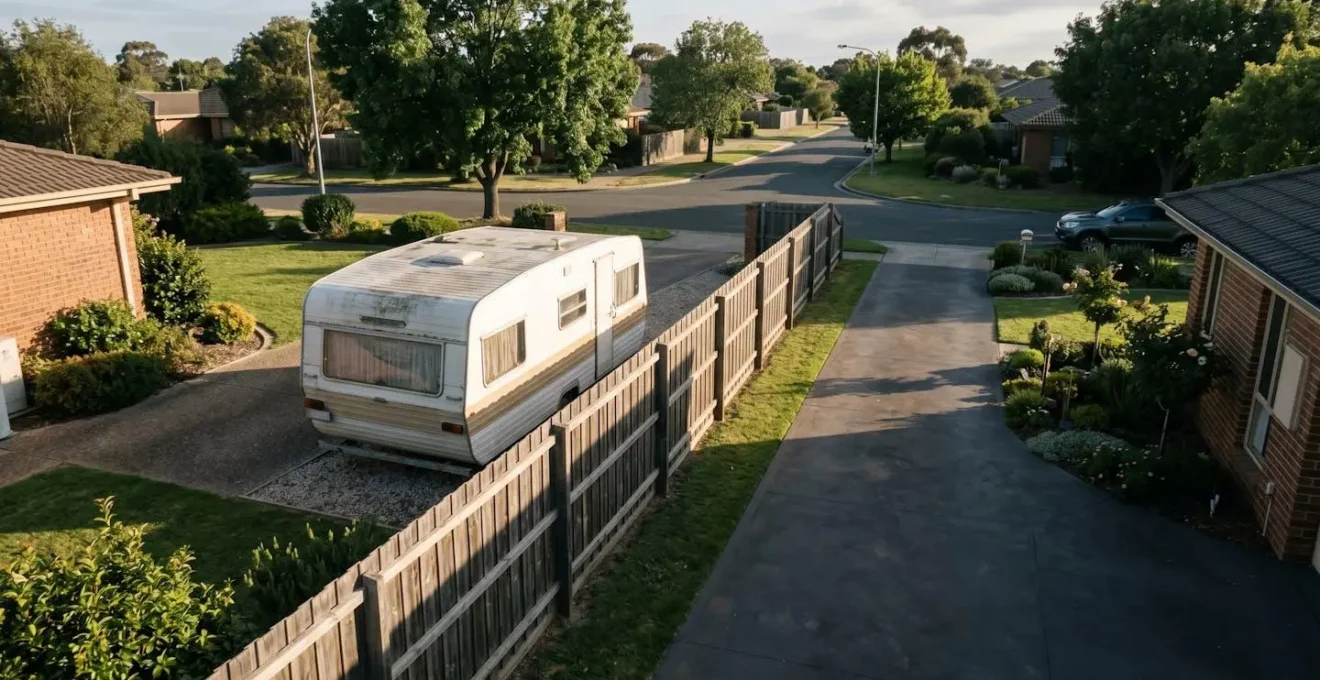
Owning your home doesn’t always mean you can do what you want with it. Your property’s title deeds often contain decades-old restrictive covenants and other legal notices that can dictate anything from what you can build to where you can park. Rather than seeing these as absolute barriers, this guide reframes them as a legal chessboard. By understanding the mechanisms of their enforcement, the available workarounds, and how to proactively manage your title, you can move from being a passive rule-follower to an empowered owner who strategically navigates their property rights.
You’ve bought the house. The keys are in your hand. That feeling of absolute ownership is unparalleled. You start making plans: a small extension for the growing family, replacing that dreary garden fence, or maybe even parking that caravan you’ve always wanted in the drive. Then, a letter arrives. Or a neighbour casually mentions a “rule” you’ve never heard of. Suddenly, your castle feels less like your own. This scenario is the unwelcome reality for many homeowners who discover their property is bound by legacy instruments they never knew existed: restrictive covenants, unilateral notices, and other annotations on the title register.
Most advice focuses on the obvious: “check your deeds.” But this is only the first step. The real challenge lies in interpreting what you find. Many homeowners feel trapped, believing these century-old prohibitions are unchangeable. They might hear about indemnity insurance as a quick fix, but rarely understand its limitations or strategic use. The truth is, these restrictions are not static pronouncements; they are part of a dynamic legal framework with rules of engagement, specific enforcement mechanisms, and, crucially, strategic countermeasures. They are a puzzle to be solved, not just a command to be obeyed.
This article moves beyond simply listing what you can’t do. As a property rights specialist, my goal is to arm you with the legal insight to understand the ‘why’ and ‘how’ behind these restrictions. We will deconstruct the power of a unilateral notice, explore why some obligations don’t automatically pass to new owners, and outline the proactive steps for achieving good “title hygiene.” By understanding this legal chessboard, you can better defend your position, challenge outdated rules where possible, and make informed decisions about managing the true scope of your ownership.
To navigate this complex legal landscape, this guide breaks down the most common and impactful restrictions you might find on your property title. We will explore each one, not just as a problem, but as a specific legal mechanism you can understand and manage.
Summary: Navigating the Hidden Rules of Your Property Title
- How to insure against breaching a 100-year-old restrictive covenant?
- What is a Unilateral Notice on a title and how does it block a sale?
- Why positive covenants (obligations to pay) do not always run with the land?
- How to ensure all previous mortgage charges are removed at the Land Registry?
- Buying a house with a TPO: Why you can’t just chop down that oak tree in the garden?
- Buying in a Conservation Area: What specific restrictions will limit your renovation plans?
- The T-mark on the plan: Who really owns and maintains the garden fence?
- Freehold vs Leasehold: What are the real ownership risks of buying a leasehold house?
How to insure against breaching a 100-year-old restrictive covenant?
You’ve discovered a covenant from 1925 forbidding any structure other than a single dwelling house, just as your conservatory foundations are being laid. This is a classic scenario where a breach, however unintentional, has occurred. When removing or modifying the covenant is not practical, the primary tool for risk management is Restrictive Covenant Indemnity Insurance. This is not a “get out of jail free” card, but a financial shield. It doesn’t make the breach legal; it protects you from the financial consequences if the beneficiary of the covenant (the person with the right to enforce it) takes legal action.
The policy is a one-off payment, and the cost varies depending on the perceived risk and the value of the property. For most standard residential breaches, the premium can be surprisingly affordable, with conveyancing data showing a typical range of £200 to £2,000 for a one-off payment. However, the crucial rule is that you cannot obtain a policy if the beneficiary has already been alerted to the breach. Contacting them is an absolute bar to getting cover. The insurance is for a risk that is currently unknown to the enforcing party.
Strategically, this policy is often a commercial decision made during a property transaction to allow a sale to proceed smoothly. It provides peace of mind not just for you, but for your mortgage lender and any future buyers, as the policy typically passes with the property. It is designed to cover a specific, known breach. The scope of that cover is clearly defined and protects against several key financial losses.
- Legal defence costs if enforcement action is taken by the covenant beneficiary
- Compensation payments ordered by a court for breach of covenant
- Cost of reinstating or demolishing unauthorised works if required
- Reduction in property market value due to covenant enforcement
- Protection for future owners and mortgage providers as the policy passes on indefinitely
Therefore, while it doesn’t grant permission, the policy effectively neutralises the financial threat, making the breach a manageable risk rather than a catastrophic obstacle.
What is a Unilateral Notice on a title and how does it block a sale?
Far more immediately disruptive than a historic covenant is the appearance of a Unilateral Notice on your title register. Unlike a covenant, which is a property-based rule, a Unilateral Notice is a claim by a third party asserting an interest in your property. This could be a disputed transfer of ownership, an unpaid debt secured against the property, or a claim by a spurned business partner. The key issue is that the notice can be registered at HM Land Registry without the owner’s consent or initial proof. It acts as a powerful warning to any potential buyer or lender that a dispute exists.
The mechanism by which it blocks a sale is simple but brutally effective: no sane conveyancer or mortgage lender will proceed with a transaction on a property with a Unilateral Notice clouding the title. The risk that the third party’s claim could be successful—potentially leading to loss of the property or a large financial liability—is too great. It freezes the property’s marketability, turning a prime asset into an untouchable liability overnight. The homeowner is notified after the notice is registered and has the right to object and apply for its cancellation, but this begins a legal process that takes time and money.
The burden of proof then shifts. The person who registered the notice (the beneficiary) must prove their claim is valid to the Land Registry Adjudicator. If they cannot, the notice will be removed. This system is designed to protect legitimate interests, but it can be weaponised to frustrate a sale or exert pressure in a dispute, as the following case illustrates.
Case Study: Godfrey v Torpey (2006)
In this case, a claimant registered a unilateral notice based on a claim for an unsecured debt, arguing it was a “pending land action.” The property owner objected, stating that an unsecured debt did not create a valid interest in the land. While the court ultimately refused the owner’s application to cancel the notice at that stage, it imposed a crucial condition: the claimant had to provide an “undertaking in damages.” This meant they had to formally promise to cover any financial loss the property owner suffered because of the notice if their claim ultimately failed. This highlights a key defensive tool: making the claimant financially liable for a speculative or malicious notice.
Why positive covenants (obligations to pay) do not always run with the land?
While restrictive (or negative) covenants that forbid an action generally “run with the land” and bind all future owners, the same is not true for positive covenants. A positive covenant is an obligation to do something, most commonly to spend money—for example, to maintain a shared driveway or contribute to the upkeep of a fence. The legal principle at common law is clear and has been a cornerstone of property law for centuries.
It is a well-established common law principle that the burden of a positive freehold covenant does not run with the land.
– LexisNexis Legal Glossary, Positive covenant legal definition
This means that when a freehold property is sold, the new owner is not automatically bound by the original promise to pay for or perform an action. The “burden” of the promise does not automatically pass to them. This creates a significant problem for developers or neighbours who rely on these contributions for the management of communal areas. If the obligation is broken with each sale, the entire system of maintenance can collapse. To overcome this, property lawyers have developed several clever legal workarounds to ensure these obligations remain enforceable against successive owners.
These methods effectively create a new obligation on each sale or attach such severe consequences to non-compliance that the new owner is compelled to adhere to the positive covenant. They are a testament to how legal strategy is used to plug gaps in common law. Understanding these mechanisms is key to recognising when a demand for payment is legally enforceable.
- Chains of indemnity: The most common method. When the property is sold, the seller requires the buyer to enter a new covenant to indemnify them against any future breach. This creates a personal chain of contracts linking back to the original owner.
- Compulsory renewed covenants: The deeds may contain a restriction preventing the sale of the property unless the new buyer enters into a direct covenant with the original beneficiary.
- Right of entry annexed to an estate rentcharge: A developer can attach a small rentcharge to the property. If the positive covenant (e.g., to pay a service charge) is breached, the rentcharge owner has a powerful right to enter the property or even grant a lease on it, effectively forcing compliance.
- Use of leasehold title: This problem doesn’t exist in leasehold, as both positive and negative covenants are enforceable through the landlord-tenant relationship, which is one reason many new-build estates use leasehold structures even for houses.
How to ensure all previous mortgage charges are removed at the Land Registry?
When you buy a property, your solicitor is meant to ensure that the seller’s mortgage is paid off and the lender’s “charge” over the property is removed from the title register at HM Land Registry. But mistakes happen, and sometimes old, satisfied charges remain on the title like digital ghosts. This can cause major delays and complications when you come to sell or remortgage. It’s a critical piece of title hygiene to ensure your register is clean. A charge gives a lender the right to repossess and sell your property if the loan is not repaid, so an un-removed charge—even for a paid-off mortgage—is a serious defect.
The process of removal relies on the lender sending a formal notification of discharge to the Land Registry. In the past, this was done via a paper form DS1. Today, it’s mostly electronic. However, the system is not infallible and has been subject to error and even fraud. Proactively checking your own title register is a wise move, especially if you have owned your property for a long time. You can order an official copy from the Land Registry for a small fee and check the “C: Charges Register” section. If you see a charge from a lender you paid off years ago, you must take action to have it removed.
Case Study: The risk of fraudulent discharge (based on Turner v DB Bank)
In a notable case, property owners managed to fraudulently remove a bank’s charge from their property by submitting a forged DS1 discharge form to the Land Registry. Their own solicitors submitted it without verifying its authenticity with the bank. The charge was removed, allowing the owners to secure a new loan from a different lender (Santander), who then registered their own charge against the now “clear” title. When the original bank (DB Bank) discovered the fraud, a legal battle ensued. An adjudicator ruled that DB Bank’s charge should be reinstated, but crucially, it would now rank *after* Santander’s new charge, severely damaging DB Bank’s security. This case exposed vulnerabilities and led to much stricter identity and verification checks for discharging mortgages.
This demonstrates that the integrity of the register is paramount and that proactive verification is the only way to be certain your title is clear of legacy instruments. The process is straightforward but requires diligence.
Your action plan for clearing old mortgage charges
- Order Official Copy: Obtain an up-to-date official copy of your title register from HM Land Registry to see what charges are currently registered.
- Identify Historical Charges: Review the Charges Register for any mortgages that you have fully repaid but which are still listed.
- Contact the Lender: Get in touch with the original lender (or their successor company) to request they submit the necessary discharge documentation.
- Submit Discharge Form: If the lender provides a DS1 form, ensure it is correctly submitted to the Land Registry. For modern loans, the lender should send an electronic discharge (ED) directly.
- Verify Removal: After a few weeks, order another official copy of the register to confirm that the charge has been successfully removed.
Buying a house with a TPO: Why you can’t just chop down that oak tree in the garden?
Moving from private rules to public law, one of the most powerful restrictions on a homeowner’s freedom is a Tree Preservation Order (TPO). If a tree on your property is protected by a TPO made by the local council, you cannot cut it down, prune it, or carry out any work that might damage it without formal written consent. The motivation is to protect trees that provide significant public amenity value, whether for their beauty, age, or contribution to the local landscape. Ignorance of a TPO is no defence, and the financial penalties for breaching one are severe and can be life-altering.
Unlike a restrictive covenant, where enforcement might be uncertain, a TPO is enforced vigorously by the local authority. Fines are determined by the courts and are unlimited. In serious cases, they are calculated based on the financial gain the offender made from the breach—for example, the increase in property value from gaining a better view. As a result, recent prosecutions have resulted in fines of £15,000 for a protected willow and a staggering £60,000 for a single mature oak tree. A criminal record can also result from a breach.
It’s crucial to differentiate a TPO from the lesser restrictions that apply to trees within a Conservation Area. While both require interaction with the council, the process and legal weight are vastly different. A TPO places a much higher burden of proof on the owner to justify any proposed works, whereas the Conservation Area rules are based on a notice period.
| Aspect | Tree Preservation Order (TPO) | Conservation Area |
|---|---|---|
| Approval Requirement | Explicit permission required through formal application process | Only need to give 6 weeks’ notice of intention to do works |
| Application Burden | Much higher bar – must prove works are necessary and justified | Lower bar – council can object but default is approval after notice period |
| Protected Works | Felling, severe pruning, root cutting, any work affecting tree health/appearance | Mainly applies to felling or significant works on trees over a certain diameter |
| Penalties for Breach | Unlimited fine, potential criminal record, ‘Proceeds of Crime’ calculations based on property value increase | Generally lower fines as enforcement is less stringent |
| Emergency Dead Tree Exception | 5-day notice required but burden of proof on owner to demonstrate tree was dangerous | Similar notice requirement but less scrutiny in most cases |
Buying in a Conservation Area: What specific restrictions will limit your renovation plans?
If a Tree Preservation Order is a rifle shot aimed at a single tree, designation as a Conservation Area is a protective blanket thrown over an entire neighbourhood. When you buy a property in a Conservation Area, you are not just buying a home; you are becoming a custodian of its historical and architectural character. This status, granted by the local council, introduces a whole new layer of planning control designed to prevent inappropriate development that would erode the special character of the area.
These controls go far beyond what is normally required under “permitted development” rights, which are often removed or curtailed. While many owners are aware of the major restrictions—such as needing permission for extensions or demolitions—it is the granular, highly specific details that often catch them out. The council’s goal is to preserve a cohesive aesthetic, and this extends to the smallest elements of your home’s exterior. Failure to comply can result in an enforcement notice demanding you reverse the works at your own expense.
The restrictions are not intended to fossilise an area but to manage change sensitively. However, this means your renovation plans will be subject to intense scrutiny. The choice of materials, colours, and designs is not yours alone. You must work within a palette and specification dictated by the local authority’s conservation officer, whose job is to uphold the area’s unique identity. This can significantly increase the cost and complexity of even simple maintenance tasks.
Before undertaking any external work, it is essential to consult the specific guidance for your Conservation Area. Commonly overlooked restrictions can derail a project and lead to costly disputes. These often include:
- Exact mortar type and composition for brickwork repointing (e.g., lime mortar often required instead of modern cement).
- Window frame profile and material specifications (requiring expensive timber sash windows instead of standard uPVC).
- Drainpipe and gutter materials and colours (cast iron or specific heritage-style plastics may be mandated).
- Front door colour palette restrictions, often limited to a pre-approved list of “heritage” colours.
- Roof tile material and colour, which must match the original or surrounding properties.
- Chimney pot retention, even if the fireplace is no longer in use.
- Front boundary treatments, including the design of walls, railings, and gates.
The T-mark on the plan: Who really owns and maintains the garden fence?
From the sweeping controls of a Conservation Area, we now zoom in to one of the smallest yet most contentious symbols in property law: the ‘T-mark’ on a title plan. Disputes over fences and boundaries are a perennial source of neighbourly conflict. The title plan, a map filed at the Land Registry, is the starting point for resolving these disputes, and the T-mark is a key piece of evidence. It is a small ‘T’ drawn on the plan with the bar of the ‘T’ resting on a boundary line. The convention is simple: if the ‘T’ is on your side of the line, you are presumed to own that boundary feature and are responsible for its maintenance.
Where you see an ‘H-mark’—which is effectively two T-marks joined together—it indicates a party wall or shared boundary, with joint maintenance responsibility. However, the absence of a T-mark does not mean ownership is unknown. In such cases, other legal presumptions may apply, such as the convention that a fence owner has the “good side” facing their neighbour, with the posts and rails on their own side. But this is merely a presumption, not a rule of law, and can be rebutted by other evidence. The T-mark is a much stronger indicator.
However, even a clear T-mark is not the final word. The title plan only shows the “general boundaries” and is not intended to be a precise, centimetre-accurate record. Long-standing verbal agreements, patterns of historic maintenance, or a process known as adverse possession (where someone has occupied and treated land as their own for a sufficient period) can all potentially override what is shown on the plan. The plan is the starting point of the investigation, not the end. A thorough interpretation requires looking at the plan, the title register, and the physical reality on the ground.
To avoid conflict, it is crucial to understand how to interpret these markings correctly when you buy a property.
- T-mark on your side of boundary line: You are presumed to own and be responsible for maintaining that boundary feature.
- H-mark (two T-marks joined): This indicates a party wall or shared boundary with joint maintenance responsibility.
- No T-mark shown: Ownership is not explicitly defined. Look for other evidence or presumptions, but do not assume ownership.
- Verbal agreements override marks: A long-standing, accepted boundary agreement between neighbours can be more powerful than the original plan.
- Check the title register text: The deeds may contain supplementary text that clarifies or even contradicts the symbols on the plan. Always read both together.
Key takeaways
- Restrictive covenants and other title issues are not just static rules but a legal chessboard where understanding the mechanisms is key to empowerment.
- Proactive “title hygiene,” such as checking for and removing old mortgage charges, is a crucial part of property ownership.
- The distinction between private rules (covenants), statutory controls (TPOs, Conservation Areas), and fundamental ownership structure (Leasehold) dictates the nature and severity of the risks you face.
Freehold vs Leasehold: What are the real ownership risks of buying a leasehold house?
Ultimately, many of the risks discussed—from positive covenants to permission fees—are magnified or fundamentally altered by the very nature of your ownership: Freehold versus Leasehold. While traditionally associated with flats, the “leasehold house” has become common on new-build estates, bringing with it a host of ownership risks that are alien to the traditional freeholder. Owning a freehold gives you ownership of the property and the land it stands on, in perpetuity. Owning a leasehold is effectively a long-term rental agreement with a landlord (the freeholder), where you own the right to occupy the property for a set number of years.
This fundamental difference creates a power imbalance. The freeholder can charge ground rent, demand fees for permissions to alter the property, and levy service charges for estate maintenance. These costs are often uncapped and can escalate dramatically. Furthermore, the value and mortgageability of your home are directly tied to the length of the remaining lease. As the term shortens, especially once it drops below 80 years, the cost of extending it skyrockets due to a legal concept known as “marriage value”.
The Marriage Value Trap
When a lease with less than 80 years remaining is extended, the law states the leaseholder must pay the freeholder 50% of the “marriage value.” This is the uplift in the property’s value created by the new, longer lease. For example, a flat worth £300,000 with a 75-year lease might be worth £350,000 with a 90-year extension. The marriage value is £50,000. The leaseholder must pay a £25,000 “marriage value” fee to the freeholder on top of the standard premium for the extension. This acts as a severe financial penalty for letting a lease run short and makes extensions prohibitively expensive for many.
The modern leasehold house combines the burdens of maintaining a whole house with the liabilities of a leaseholder, creating a uniquely challenging ownership model. It is a structure designed to create a long-term income stream for the developer or the investment company they sell the freehold to.
| Ownership Feature | Traditional Freehold | Modern Leasehold House |
|---|---|---|
| Ground Rent | None | Often starts low but may double every 10-25 years (£250 to £500+ annually) |
| Permission Fees | Not applicable | £2,000-£5,000 for extensions, conservatories, or significant alterations |
| Lease Term Anxiety | Ownership is perpetual | Decreasing lease term affects property value and mortgageability |
| Freeholder Sale Risk | Not applicable | Developer can sell the freehold to an investment company without your consent |
| Service Charges | Direct responsibility for property | Annual charges for estate maintenance, often increasing without leaseholder control |
Ultimately, navigating the complexities of your property title is the true test of ownership. By moving beyond passive acceptance and arming yourself with a strategic understanding of these legal instruments, you can protect your investment and assert your rights. To put these insights into practice, the next logical step is to secure a comprehensive review of your own title deeds and legal position.