
Contrary to popular belief, winning a neighbour dispute isn’t about proving you’re right—it’s about understanding the legal and financial leverage that forces a resolution.
- A right is meaningless if the cost of enforcing it is too high; your strategy must account for this from day one.
- Invisible rules, like rights of way acquired through long-term use, often have more power than what is written in your deeds.
- Strategic tools like indemnity insurance and pre-court protocols can neutralise a threat or strengthen your negotiating position before lawyers are even called.
Recommendation: Before engaging in any conflict, objectively assess the cost of enforcement and identify your opponent’s key legal and financial leverage points.
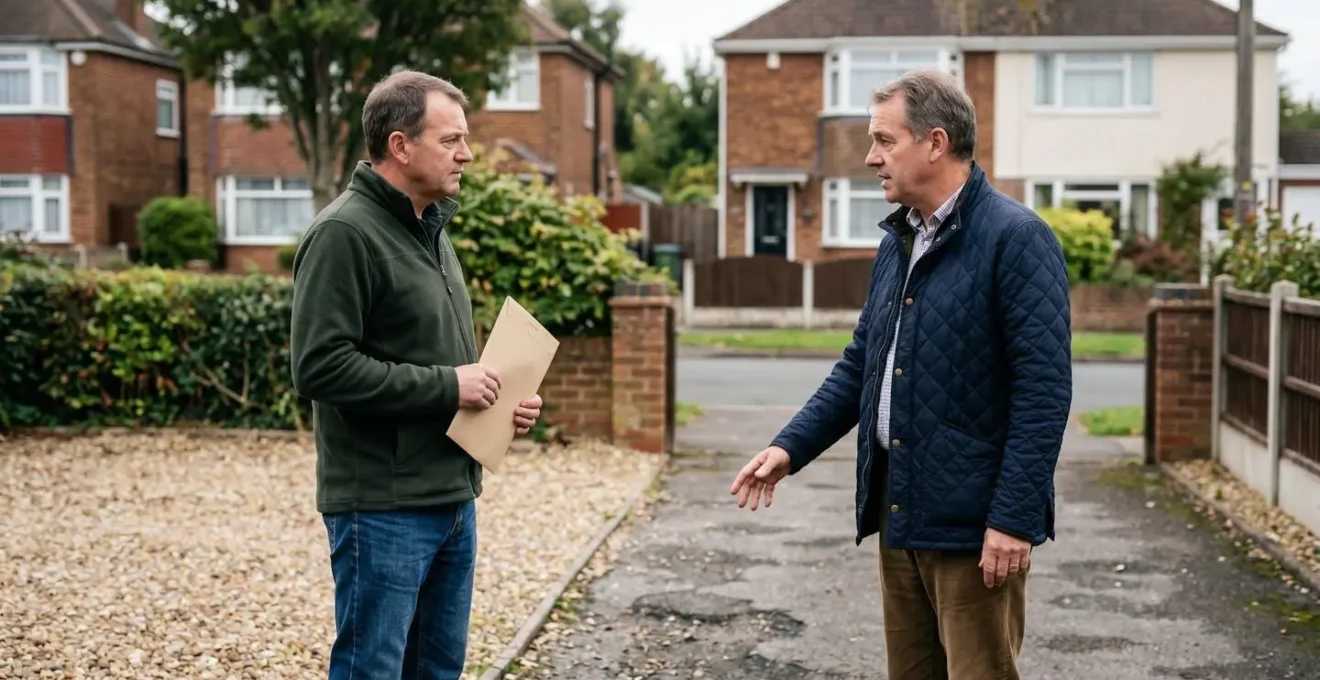
When a dispute arises over a shared driveway, a garden fence, or an extension, the common advice is to “have a friendly chat” and “check your property deeds.” For many homeowners embroiled in conflict, this feels woefully inadequate. You’re not just arguing over parking spaces; you’re fighting for access, privacy, and the peaceful enjoyment of your home. These conflicts are rarely resolved by goodwill alone because they aren’t simply social disagreements—they are contests of legal rights and financial leverage.
The documents you hold are often just the starting point. Decades of unwritten use, obscure 100-year-old rules, and the sheer cost of legal action create a complex battlefield. The neighbour who appears to be in the wrong may hold a surprising amount of leverage, while the one who is legally “right” may find the cost of proving it prohibitive. This is the reality of property disputes that standard advice fails to address.
But what if the key wasn’t about being right, but about being strategic? This guide moves beyond the platitudes. We will dissect the hidden mechanics of property law, treating each dispute not as a social problem, but as a negotiation where knowledge of the rules, the costs, and the potential outcomes dictates your success. We will explore how rights are created from thin air, how to force access when it’s denied, and how to use modern legal tools to neutralise ancient restrictions.
By understanding these principles, you can shift from feeling like a victim of circumstance to a strategic player, equipped to negotiate a resolution from a position of strength, or to decide, pragmatically, which battles are worth fighting.
This article will guide you through the critical legal leverage points in common neighbour disputes. Below is a summary of the strategic issues we will dissect to help you navigate these complex situations.
Summary: Navigating Property Rights and Neighbour Disputes
- How 20 years of uninterrupted use can create a legal right of way across your land?
- Planning an extension: Can your neighbor block it by claiming a ‘Right to Light’?
- Access to Neighbouring Land Act: How to force access to a neighbor’s land to fix your wall?
- Wayleave Agreements: How much should the electricity company pay to have a pylon on your land?
- Who is responsible for a blocked shared drain on private land?
- The T-mark on the plan: Who really owns and maintains the garden fence?
- How to insure against breaching a 100-year-old restrictive covenant?
- Freehold vs Leasehold: What are the real ownership risks of buying a leasehold house?
How 20 years of uninterrupted use can create a legal right of way across your land?
A right of way that isn’t written in any deed can be one of the most potent and unsettling aspects of UK property law. This is known as an “easement by prescription,” and it can be legally established if someone has used a path or access across your land without force, without secrecy, and without permission for a continuous period. The critical timeframe, according to UK property law, is a minimum of 20 years’ continuous use.
The principle hinges on the idea that the law presumes a historic legal grant was made. If a neighbour (or their predecessors) has been driving over the edge of your property to reach their garage for two decades, the law may conclude they have a legal right to continue doing so, even if you object. The use must be “as of right,” meaning they acted as if they were entitled to it. A simple verbal permission given years ago can, paradoxically, defeat such a claim, as it demonstrates the use was not “as of right” but by consent.
This creates a significant leverage point. For the user, demonstrating a long history of use is a powerful tool. For the landowner, proving that permission was once granted, or that the use was interrupted or contentious, is a critical defense.
Case Study: The Power of Predecessors in Welford v Graham
The landmark 2017 ruling in Welford v Graham significantly impacted how the 20-year period is calculated. The UK Upper Tribunal established that a current property owner does not need to have personally used the right of way for the full 20 years. They can rely on the use by their predecessors in title. This means the 20-year period can be accumulated across multiple owners of the neighbouring property. This precedent makes it easier for claimants to establish a prescriptive easement based on historical use, placing a greater burden on landowners to be aware of and, if necessary, formally challenge any long-standing, unapproved access across their property.
The key takeaway for any landowner is that ignoring long-standing use is a high-risk strategy. If you see a potential prescriptive right developing, you must take clear, documented action to either grant formal, revocable permission (a license) or to physically and legally interrupt the use. Silence is not a defense; it can be interpreted as acquiescence.
Planning an extension: Can your neighbor block it by claiming a ‘Right to Light’?
The ‘Right to Light’ is an ancient, and often misunderstood, legal easement that protects a property’s historical access to natural illumination. If a window has received natural daylight for over 20 years without interruption, it may have acquired a legal right to continue doing so. This means your neighbour could potentially block or demand significant alterations to your planned extension if it infringes upon this right. This is not a matter for the planning department; it is a private property right that operates entirely separately.
An infringement occurs if your development would reduce the light in a neighbour’s room to a level where it is considered inadequately lit for its ordinary use. This is often assessed using a complex “50/50 rule” where experts calculate whether 50% of the room still receives 1 ‘lumen’ of light. The financial consequences of a dispute are severe; property market analysis shows active disputes can lead to a 10-30% decrease in property value. This potential loss represents a major leverage point for the affected neighbour in negotiations.
For a developer or homeowner planning an extension, ignoring a potential Right to Light claim is a significant gamble. A neighbour with a valid claim could seek an injunction to stop construction or even, in rare cases, demand the demolition of a completed structure. More commonly, they will negotiate for a substantial compensation payment in exchange for releasing their right. The cost of being wrong can be financially devastating, far exceeding the cost of proactive assessment and negotiation.
The strategic approach is to address this head-on. Commissioning a specialist surveyor early in the design process to model the light impact is crucial. This not only quantifies the risk but also provides a factual basis for negotiation, moving the conversation away from emotional claims and towards a data-driven resolution. This knowledge allows you to either redesign the project to avoid infringement or to budget for a negotiated settlement.
Access to Neighbouring Land Act: How to force access to a neighbor’s land to fix your wall?
What happens when you need to repair your property, but the only way to do it is from your neighbour’s garden? If your neighbour refuses access, you are not powerless. The Access to Neighbouring Land Act 1992 provides a legal mechanism to obtain a court order forcing them to grant temporary access. This Act is a powerful tool, but it is not a blank cheque; its use is strictly defined and courts expect you to have exhausted all reasonable attempts at negotiation first.
The Act allows the court to grant an “access order” if the works are reasonably necessary for the preservation of your property and cannot be carried out, or would be substantially more difficult to carry out, without entering the neighbouring land. “Preservation” is key; the Act is designed for essential repairs like fixing a leaking roof, re-pointing a crumbling wall, or clearing a blocked gutter—not for cosmetic improvements or new-build extensions. This distinction between preservation and improvement is a critical battleground in any potential court application.
Case Study: The High Court Defines ‘Preservation’ in Prime London Holdings v Thurloe Lodge
In a landmark 2022 case, the High Court considered the 1992 Act for the first time in 30 years. A developer needed access to a neighbour’s land to re-render and repaint a boundary wall. When access was refused, they sought a court order. The court’s judgment was pivotal: it established that re-rendering constituted ‘basic preservation work’ necessary to protect the wall’s structure, falling squarely within the Act’s scope. This case provides a strong precedent that essential maintenance, even if it involves new materials, can be legally enforced, giving property owners a clear leverage point against uncooperative neighbours.
Before ever reaching court, your actions will be scrutinised. You must be able to demonstrate that you have acted reasonably, provided clear details of the proposed works, offered assurances to protect their property, and tried to agree on a schedule. Failure to build this paper trail of good faith significantly weakens your position and increases your legal costs.
Action Plan: Pre-Court Protocol for Requesting Land Access
- Document the necessity: Prepare detailed specifications showing why the works are reasonably necessary for the preservation of your property and why access cannot be avoided.
- Send formal written request: Submit a comprehensive letter to your neighbor detailing the exact nature of the works, justification, proposed access schedule, duration, contractor details, and proposed protections for their property.
- Create pre-access condition report: Commission professional time-stamped photographic and video documentation of the neighbor’s property before any works commence to protect against false damage claims.
- Offer reasonable terms: Propose specific protections including insurance coverage, agreed working hours, designated access routes, and commitment to restore their land to its original condition.
- Demonstrate good faith: Show willingness to accommodate your neighbor’s concerns, adjust schedules for their convenience, and provide regular progress updates, establishing court-ready evidence of attempted cooperation.
Wayleave Agreements: How much should the electricity company pay to have a pylon on your land?
A wayleave agreement is a contract that grants a utility company the right to install, maintain, or repair their equipment (like pylons, poles, or underground cables) on private land. It is not an easement; it’s a personal, contractual licence that does not automatically transfer to new landowners. In return for this intrusion, the landowner is entitled to compensation. The crucial question is: how much? The answer depends heavily on the type of equipment and the level of impact on your property.
Compensation is typically structured in two parts: a one-off payment for the initial installation and an annual payment for the ongoing presence of the equipment. For more permanent installations, especially large pylons, a utility company may seek a permanent easement, which involves a significantly larger one-off payment reflecting the long-term “sterilisation” of that portion of your land. Understanding the difference between a temporary wayleave and a permanent easement is the first step in any negotiation.
The leverage a landowner holds is directly related to the company’s need for that specific route and the impact of the apparatus. A single wooden pole in the corner of a large field has a low impact and thus commands a lower payment. A towering steel pylon in the middle of a development plot has a massive impact, potentially devaluing the entire property, and therefore justifies a much higher claim for compensation.
The following table, based on an analysis of typical compensation rates, illustrates how these payments can vary. It serves as a general guide, as final figures depend on specific site characteristics and professional negotiation.
| Equipment Type | Permanent Easement Payment | Annual Wayleave Payment | Impact Level |
|---|---|---|---|
| Large metal pylon | 3-6% of property value | Several thousand pounds | High visual and land use impact |
| Wooden pole (single) | 1-2% of property value | £7-300 annually | Moderate impact |
| Underground cables | Few hundred pounds one-off | Minimal annual payment | Low visibility, land use restrictions |
| Overhead wires (span) | Case-dependent valuation | £100-500 annually | Airspace intrusion |
Negotiating with a large utility company can be intimidating, but landowners are not without power. The law, particularly the Electricity Act 1989, provides a framework for these agreements. Engaging a specialist surveyor or solicitor who understands this niche area is often a wise investment, as their fees are frequently covered by the utility company as part of the final settlement. They can ensure you are not only compensated for the land taken but also for any depreciation in the value of your remaining property.
Who is responsible for a blocked shared drain on private land?
A blocked drain shared between several properties is a common and unpleasant problem that can quickly escalate into a bitter dispute. The core of the issue is determining liability. The responsibility for drain maintenance shifted significantly in 2011, when water companies became responsible for most shared sewer pipes. However, there is a crucial exception: the section of a drain that serves multiple properties but is still located on private land before it connects to the main public sewer often remains the joint responsibility of the homeowners it serves.
When a blockage occurs in one of these privately shared drains, the default legal position is that all homeowners who use that drain are jointly responsible for the cost of clearing it. This is where the disputes begin. The “upstream/downstream” principle is often cited: if the blockage is physically located on your property, you may be seen as primarily responsible, even if the cause originated from a neighbour “upstream.” However, the fairest and most legally sound approach is proportional cost-sharing.
The first step in resolving any dispute is diagnosis, not accusation. Before any discussion of cost, it is essential to establish the exact location and cause of the blockage. A professional CCTV drain survey is an indispensable tool. It provides indisputable video evidence of the problem, allowing for a fact-based negotiation. Without this proof, you are simply arguing opinions, which is a recipe for stalemate and escalating animosity.
Once the problem is identified, the most effective long-term solution is to move beyond the immediate repair and create a formal agreement for future maintenance. A simple “drainage maintenance fund” or a written agreement to split the cost of annual jetting can prevent future disputes entirely. This transforms the problem from a recurring crisis into a manageable, shared utility, reflecting the reality of shared infrastructure. This proactive approach is the hallmark of a successful resolution.
The T-mark on the plan: Who really owns and maintains the garden fence?
The “T-mark” on a conveyance plan is one of the most frequently misunderstood symbols in neighbour law. Many homeowners believe that if the ‘T’ is on their side of the boundary line, it definitively proves they own the fence and are solely responsible for its maintenance. This is a dangerous oversimplification. At best, a T-mark on a plan creates a legal presumption of ownership and responsibility, but it is not conclusive proof.
These presumptions can be overturned by other evidence. For example, a clause in the property deeds might state something different (“the purchaser shall maintain the fence on the western boundary”), which would override the T-mark. Furthermore, the behaviour of the parties over many years can create a new reality. If your neighbour has consistently maintained and replaced the fence for the last 30 years, they may be considered to have taken responsibility for it, regardless of what the original plan suggested. This is a form of estoppel or an implied agreement.
Where the deeds and plans are silent—which is surprisingly common—there is no general legal rule in England and Wales that dictates who owns which fence. The notion of “you own the fence on your left” is a complete myth. In the absence of a clear agreement or presumption, boundaries are often considered a shared responsibility. The most pragmatic approach is often to propose sharing the cost of repair or replacement, as both neighbours benefit from a well-maintained boundary.
The strategic ambiguity of the T-mark can be a leverage point. If it supports your position, you can present it as strong evidence. If it works against you, you can challenge it by looking for contradictory evidence in the deeds or in the history of maintenance. The key is to understand that the T-mark is the start of the investigation, not the end. It is a piece of evidence in a larger puzzle, and its power can be diminished by stronger, more direct evidence to the contrary.
Key Takeaways
- A right of way can be legally created by 20 years of unchallenged use, even with no written agreement.
- A neighbour’s ‘Right to Light’ is a private property right that can halt your extension, separate from planning permission.
- Indemnity insurance for old covenants is only valid if the beneficiary remains unaware of the breach; it’s a tool for silence, not confrontation.
How to insure against breaching a 100-year-old restrictive covenant?
Restrictive covenants are clauses in property deeds, sometimes dating back a century or more, that limit how a property can be used. They might forbid extensions, prohibit keeping livestock, or restrict the property to a single dwelling. While many are obsolete, breaching one—even unknowingly—can expose you to legal action from the beneficiary (the person or entity with the right to enforce the covenant). This is where Restrictive Covenant Indemnity Insurance becomes a crucial strategic tool.
This insurance is a one-off policy taken out to protect the owner (and their mortgage lender) against financial losses if a beneficiary attempts to enforce a covenant you have breached or are about to breach. It is a tool for managing risk, not for eliminating it. The policy’s power lies in a critical condition: it is only valid if the beneficiary remains unaware of the breach. The moment you “tip off” the beneficiary—by asking for their permission or informing them of your plans—the insurance becomes void. It is, in essence, insurance for maintaining silence.
Understanding what the policy does and does not cover is vital. This is not a magic shield that allows you to build with impunity. As a breakdown of indemnity coverage shows, its value is in mitigating financial fallout, not preventing physical consequences.
| Coverage Aspect | What IS Covered | What IS NOT Covered |
|---|---|---|
| Legal defense costs | Full solicitor and barrister fees for defending enforcement action | Costs after you informed the beneficiary of the breach |
| Property value loss | Diminution in market value if covenant enforced | Loss in value due to market conditions unrelated to covenant |
| Financial damages awarded | Compensation ordered by court to beneficiary | Damages if breach was willful after policy purchase |
| Physical structure | Never covers demolition or removal costs | Never covers the cost to undo the breach |
| Policy validity | Valid only if beneficiary remains unaware of breach | Immediately void if you notify or ‘tip off’ the beneficiary |
Strategic Alternative: Application to the Upper Tribunal
Instead of relying on insurance, a property owner can proactively apply to the Upper Tribunal (Lands Chamber) to have an obsolete covenant legally modified or discharged. This is a more confrontational but potentially more permanent solution. The Tribunal will consider if the covenant is truly obsolete due to changes in the neighborhood’s character, or if its enforcement provides no practical benefit to the beneficiary. A successful application requires a strong case demonstrating that the world has moved on and the old restriction no longer serves a reasonable purpose. This removes the risk entirely, rather than just insuring against it.
Freehold vs Leasehold: What are the real ownership risks of buying a leasehold house?
When you buy a freehold property, you own the building and the land it stands on outright. When you buy a leasehold house, you are essentially a long-term tenant who has bought the right to live in the property for a set period (often 99, 125, or 999 years). You own the lease, not the land. This fundamental difference creates a series of ownership risks and hidden costs that many buyers are unprepared for, turning the dream of homeownership into a financial trap.
The freeholder (or landlord) retains ultimate control. This means you may need their permission—and have to pay their administration fees—for activities that a freehold owner would take for granted. The lease document is the rulebook, and it can contain a minefield of restrictions and charges. This creates a significant power imbalance, where the freeholder holds all the leverage. You may find yourself paying for the “privilege” of making improvements to a property you supposedly own.
Common issues include escalating ground rents, which can sometimes double every ten years, making a property unsellable. You will also face service charges for the maintenance of common areas, which are set by the freeholder with little transparency or oversight. Furthermore, simple acts require costly consent:
- Permission to own pets: Many leases require formal consent, with admin fees ranging from £50-£200 just to keep a cat or dog.
- Window replacement approval: Changing windows, even for more efficient ones, can require freeholder permission and a fee of £100-£500.
- Building an extension: This requires freeholder consent, which can cost £200-£1000 in fees, on top of any potential increase in your ground rent.
- Permission to sublet: Renting out your property might incur a consent fee of £150-£400.
Perhaps the biggest risk is the cost of extending the lease. As a lease shortens, particularly below 80 years, the property’s value plummets, and the cost of extending it (the “marriage value”) skyrockets. You may be forced to pay tens of thousands of pounds to the freeholder to simply maintain the value of your own home. This system traps homeowners in a cycle of paying fees to a landlord they may never meet, for a property they thought was theirs.
To navigate these complex disputes effectively, you must shift your mindset from proving you are right to strategically assessing your legal and financial position. The first step is to arm yourself with knowledge. Before engaging a solicitor or confronting a neighbour, conduct a thorough audit of your own position, identify your leverage points, and calculate the potential costs of enforcement. This strategic self-assessment is the most critical action you can take.